My Perspective on Patient Education & Recovery
Why I've spent the last decade teaching patients online, what it has taught me, and where I believe hip and knee care is going next — from Matthew Harb, M.D.
Patient education is part of the operation
As a high-volume joint replacement surgeon, I've always believed that patient education is one of the most important factors in a successful outcome. Surgery is only one part of the journey. Patients who understand their condition, their options, and their recovery tend to be less anxious, more engaged, and far better prepared.
When I started creating educational content online, there was very little reliable orthopedic information coming directly from practicing surgeons. Patients were searching the internet and finding fragmented, conflicting, or confusing answers. I saw a chance to help close that gap with clear, honest resources patients could reach anytime, anywhere.
Over the years, that work has reached millions of patients and been viewed more than two billion times across YouTube, TikTok, Instagram, and Facebook. But the number that actually matters to me is a different one: the patient who tells me a video eased their anxiety, clarified their options, or helped them walk into surgery feeling prepared. Education empowers people — and it reinforces that there's rarely a one-size-fits-all answer in medicine.
Patients want to understand their care
The biggest lesson I've learned is simple: patients want to be educated. Medicine used to follow a model where a patient met a physician, got a recommendation, and followed it. Today's patients want to understand their condition, the reasoning behind a recommendation, and what alternatives exist.
They're interested in prevention, too — what exercises help, how to stay active, how to avoid future problems. Musculoskeletal conditions are often lifelong, and education is one of the most powerful tools we have to manage them. Patients are far more engaged than many physicians realize, and I think we should embrace that engagement rather than work around it.
Many patients feel they know me before we meet
Many patients tell me they feel like they know me before they ever walk into the office, because they've watched my videos. A lot of the initial rapport is already there.
When someone comes in for a hip or knee replacement consultation already understanding the basics — the procedure, the recovery timeline, the options — we don't have to spend the visit on introductions. We can focus on their specific concerns and goals. Better-informed patients feel less anxious, more prepared, and more confident — and that engagement tends to lead to better outcomes.
Newer isn't always better
Medicine is rarely as simple as it looks online. Different surgeons have different techniques, protocols, and philosophies, so educational content should be a foundation, not a substitute for individualized advice.
The harder challenge is distinguishing education from marketing. Healthcare is full of new technologies, implants, and devices that get heavily promoted — and while innovation matters, newer does not always mean better. The only question that counts is whether something meaningfully improves patient outcomes. It's the same reason I'm candid about tools like robotic surgery: I use technology when it genuinely helps and skip it when it just adds complexity.
My advice to patients is always the same: seek information from specialists who treat a high volume of the condition in question, and focus on evidence over marketing claims.
A hip replacement lasts an hour — recovery lasts months
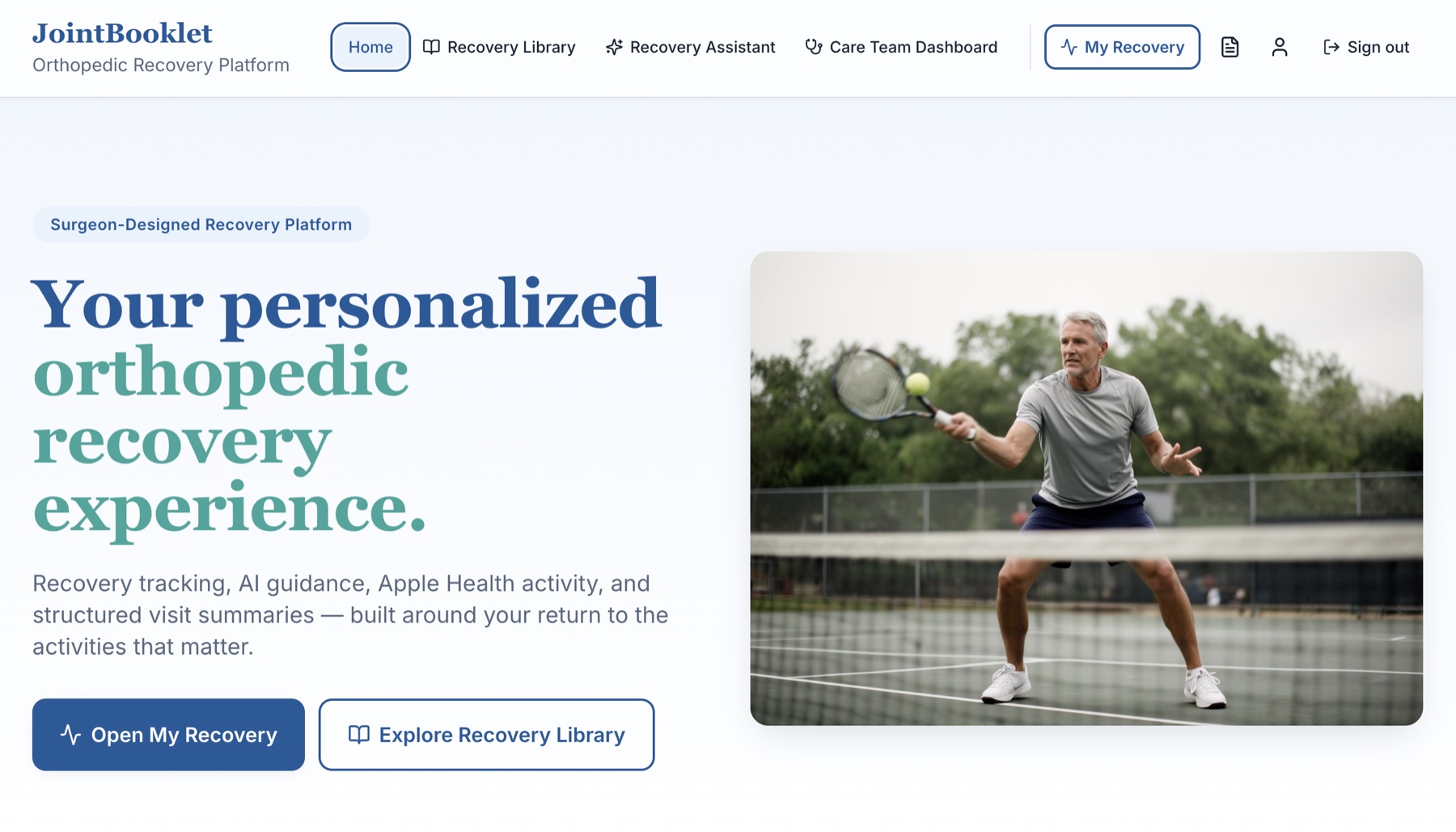
I believe technology should play a major role in both education and recovery — and that belief is what led me to build JointBooklet, a digital recovery platform for orthopedic patients. The inspiration was a printed booklet I once gave every joint replacement patient — many treated it like their personal recovery handbook. I wanted to make that interactive.
Today, patients can track their recovery, complete exercises, monitor milestones, view educational resources, ask questions of an AI assistant built around my protocols, and even connect their Apple Watch — while giving me a clearer picture of how they're doing between visits. One reality of modern care is that most of recovery happens outside the healthcare system's view. Technology lets us educate continuously, monitor progress, and catch concerns earlier than ever. (More on how I build recovery into the whole experience on why patients choose Dr. Harb.)
The next advance isn't the operation — it's everything around it
Orthopedic surgery has already achieved remarkable success. Today's implants are excellent, techniques keep improving, and outcomes are consistently strong. So the next major opportunity, I believe, isn't the operation itself — it's improving the entire experience around it.
I think the future is personalized recovery, continuous education, remote monitoring, patient-reported outcomes, and data-driven care. Patients increasingly expect healthcare to be accessible, interactive, and personal — and technology finally lets us deliver that. The future of orthopedics isn't simply performing a great surgery; it's helping patients achieve the best possible recovery after it — extending education, support, and engagement well beyond the office visit and into the months that follow. That's where I think some of the greatest advances in patient care will happen.
If you want to see how I put this into practice today, explore my patient-education library or read about how I approach hip and knee replacement.
Considering hip or knee replacement?
If my approach to education and recovery resonates with you, the best next step is a conversation — no pressure, just a clear, honest understanding of your options.
Not ready to book? Read how to choose a hip or knee surgeon