A thoughtful, experienced approach to hip & knee replacement
If you’re deciding whom to trust with your hip or knee replacement in D.C., Maryland, or Northern Virginia, you deserve more than a list of credentials. Here is how I think about this surgery, how I’m trained to do it, and what I believe matters most for your result.
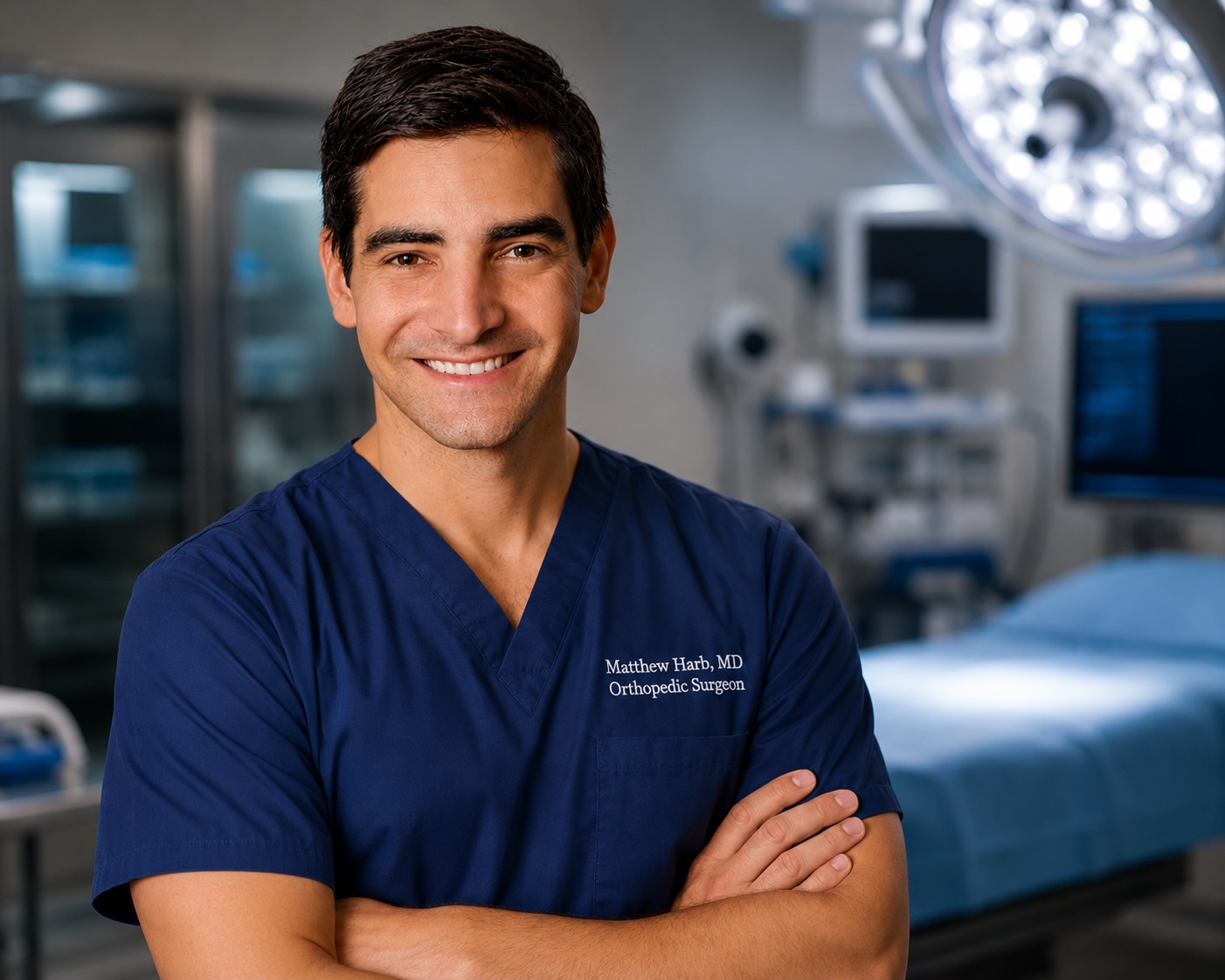
Hi — I'm Dr. Matthew Harb
I'm a board-certified orthopedic surgeon, fellowship-trained in adult reconstruction and joint replacement at the University of Virginia, and my practice is focused on hip and knee replacement.
Joint replacement isn't just the surgery itself — it's implant selection, alignment, surgical technique, and recovery. By focusing the majority of my practice on these two operations, I've developed deep experience with the wide variety of situations, anatomies, and challenges that can come up before, during, and after surgery.
600+
Joint replacements performed each year
We treat patients, not X-rays
The single idea that guides my practice is simple: we treat patients, not X-rays. Two people can have identical-looking imaging and live completely different lives — what matters is how your hip or knee is affecting you.
I believe surgery should exist for one reason: to improve your quality of life. There is no prize for suffering, and no need to wait until you can barely walk. The goal isn't a better picture on a film — it's helping you return to the activities you love, on your timeline.
And I think of recovery as something that begins before surgery and continues long after it — not a single event in an operating room, but a process we go through together.
How I approach hip replacement
Minimally invasive, muscle-sparing surgery
I specialize in the direct anterior approach, which works between the muscles rather than cutting through them. Preserving that muscle is what allows many patients to move early and recover comfortably — the foundation of a faster-recovery philosophy.
Precision through technology
I use digital templating before surgery and intraoperative fluoroscopy and computer navigation during it to confirm implant position and size and ensure the plan is executed precisely. I want to be clear about what this is and isn't: technology supports surgical decision-making and precision — it doesn't replace it. The judgment is still the surgeon's; the tools simply help execute it well.
Modern implant design
I use durable, well-proven modern implants — including a modern triple-taper titanium stem with porous surfaces that allow your own bone to grow in and secure it — paired with bearing materials chosen with long-term wear and hypoallergenic considerations in mind. Modern implants demonstrate excellent long-term durability — more than 90% intact at 30 years — though every patient and implant is individual.
How I approach knee replacement
Minimally invasive, soft-tissue–respecting surgery
My knee technique is built around respecting the soft tissues — preserving muscle and minimizing unnecessary disruption — because gentler handling supports a smoother, recovery-focused course. Where it's the right fit, that includes partial knee replacement, which preserves the healthy parts of the knee.
A modern, individualized alignment philosophy
How a knee is aligned has a real effect on how it feels and functions. I draw on a combination of mechanical and kinematic alignment principles, tailored to the individual rather than applied as a one-size-fits-all rule — a patient-specific decision about what will give your knee the most natural, comfortable result.
Precision through patient-specific planning
For knee replacement, I rely on detailed preoperative templating with computer software to plan each procedure around your specific anatomy. That plan — including implant sizing, alignment, and bone resections — is then carried into the operating room and guides the procedure. Careful planning before surgery helps support accurate implant positioning, appropriate alignment, and consistent execution of a strategy tailored to your knee.
Modern implant designs
I favor implant designs — including medial-pivot concepts — engineered for stable, natural-feeling knee mechanics, and I select the implant to fit the patient rather than the other way around.
What patients ask me most
Honest answers to the questions I hear at almost every consultation.
- Will it hurt?
- Modern joint replacement isn't the painful experience it used to be. I use multimodal, opioid-sparing pain control built around spinal anesthesia and regional nerve blocks — and most patients are up and walking the same day, not lying in bed waiting for it to pass. Discomfort is real, but it's manageable, and it's short-lived for most people.
- How long until I'm back on my feet?
- Most of my patients are standing and walking the same day as surgery, often going home a few hours later. The first two weeks focus on early mobility and protecting the new joint. By four to six weeks most patients are walking comfortably with minimal assistance and returning to many normal activities. Every recovery is individual — JointBooklet walks you through the milestones step by step.
- Will I be able to get back to the activities I love?
- For most patients, yes — and returning to the activities you love is the whole point of doing this. Modern implants are designed for an active life: golf, travel, hiking, cycling, tennis, pickleball, the gym, and keeping up with family are all routine after replacement. High-impact activities I'll talk through with you honestly and individually.
- How long will the implant last?
- Modern hip and knee implants have excellent long-term durability — more than 90% of hip replacements and around 75% of knee replacements remain intact at 30 years in current data. The technology has improved dramatically; for most patients today, a joint replacement is a once-in-a-lifetime procedure.
- What if something doesn't feel right after surgery?
- You can reach me and my team. The biggest gap I saw in joint replacement care was patients feeling alone in their recovery — which is part of why I built JointBooklet. Between in-person follow-ups, you have guided recovery education, milestone tracking, and a clear way to get answers when something comes up. You shouldn't have to wonder if what you're feeling is normal.
Recovery designed around your comfort and safety
A great operation is only half of a great result — how you recover matters just as much. My practice is built on modern rapid-recovery (ERAS) protocols:
- Multimodal, opioid-sparing pain management
- Spinal anesthesia and regional nerve blocks for comfort and a clearer recovery
- Getting you up and walking early
- Same-day (outpatient) joint replacement when it’s the right, safe choice for you
The aim of all of it is the same: to help you recover comfortably and safely. You can read more about same-day joint replacement and how I think about medications in recovery.
Where I'm genuinely different
I think the biggest gap in most patients' experience isn't the surgery — it's everything around it. So I've put real effort into education and ongoing guidance: detailed recovery timelines, preparation and exercise resources, and a full patient-education library. You can also read my broader perspective on patient education and recovery.
JointBooklet — a recovery platform I built for my patients
I built JointBooklet because I felt patients deserved more guidance after surgery than a printed packet and a follow-up appointment. It provides recovery tracking, milestone guidance, structured visit summaries, and ongoing support throughout the recovery process — built around your return to the activities that matter to you. Visit JointBooklet →

Getting you back to what matters
When I ask patients what they want, the answer is almost never “a better X-ray.” It's golf, travel, hiking, walking the neighborhood, getting back to the gym, and keeping up with family. Restoring those things — your quality of life and the activities most important to you — is the whole point of the work.
Why I chose joint replacement surgery
What drew me to joint replacement surgery is its ability to make a meaningful difference in people's lives. Patients often come to me after years of pain, limited mobility, and missed opportunities. Helping someone return to walking comfortably, traveling, golfing, exercising, or simply enjoying daily life again is incredibly rewarding.
Joint replacement combines technical precision with a clear purpose: restoring quality of life. That combination is what continues to make it such a fulfilling part of my practice.
What patients commonly tell me
“I wish I had done it sooner.”
“I was nervous about surgery.”
“I just wanted my life back.”
“I wanted to get back to golf, travel, and exercise.”
Questions worth asking any surgeon
These are the questions I would want answered if I were the patient — and they are worth asking whoever you see, not only me. If you want the fuller version, it is in how to choose a hip and knee replacement surgeon.
How do I choose a hip or knee replacement surgeon?
Look at how often the surgeon performs the specific operation you need, whether they completed fellowship training in adult reconstruction, and whether they are willing to tell you when not to operate. Volume matters because joint replacement is a technical operation that rewards repetition. Fellowship training matters because it is the year spent doing nothing but hips and knees. And a surgeon who only ever recommends surgery is telling you something about how they make decisions.
How many joint replacements should a surgeon perform each year?
Higher-volume surgeons and higher-volume hospitals have consistently better outcomes in the published literature — lower complication rates, lower infection rates, and fewer revisions. There is no single magic number, but you want someone for whom this is the main thing they do rather than one of many procedures they offer. I perform more than 600 hip and knee replacements a year.
What should I ask at a joint replacement consultation?
How many of these do you do a year? Am I a candidate yet, or is it too early? What happens if I wait? Which approach do you use and why? What does recovery actually look like week by week? And what would make you tell me not to have this surgery? That last question tells you the most about the surgeon answering it.
Where does Dr. Harb see patients and operate?
Patients are seen at the Washington, D.C. office at 1015 18th Street NW and at the Germantown, Maryland office on Observation Drive, serving the wider D.C., Maryland and Northern Virginia region. Surgery is performed at accredited hospitals and surgery centers in the area, with many patients going home the same day.
Do I need a referral to be seen?
Most patients do not, though some insurance plans require one — it is worth checking with your plan. You can call the office directly to arrange a consultation. If it turns out your problem is not something I treat, or you are not ready for surgery, you will be told that plainly rather than scheduled for something you do not need.
What if I am not ready for a joint replacement yet?
Then you should not have one, and I will tell you so. A large part of what I do in the office is deciding that someone is too early, and going through what to do in the meantime — activity changes, strengthening, weight, injections. Coming in does not commit you to surgery; it tells you where you actually stand.
Rated 5.0 from 575 patient reviews
“A really smooth operation — I was discharged the same day and basically able to walk easily within a day.”
“I walked into the surgical center in great pain and walked out with a new knee and a renewed person.”
“My full knee replacement is a big success — six months after surgery I’m hiking and kayaking again.”
Considering hip or knee replacement?
The best next step is a conversation — no pressure, just a clear, honest understanding of your options. Explore Dr. Harb’s hip and knee replacement options or request a consultation.